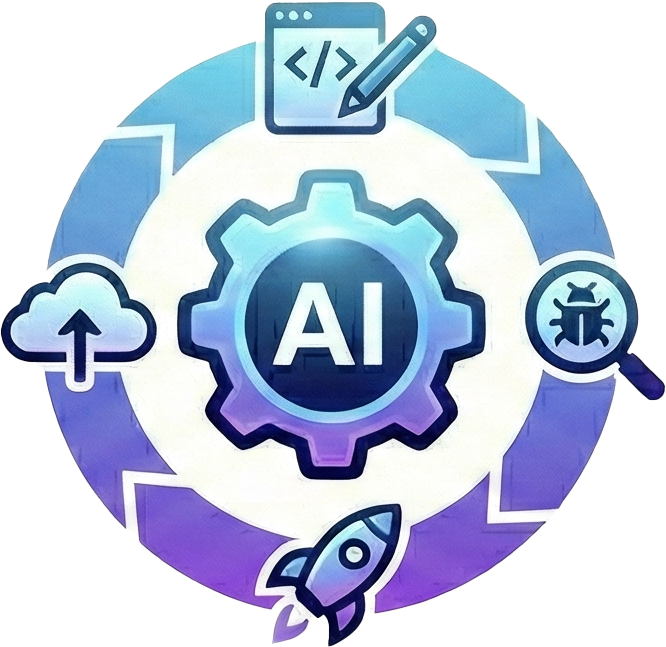
The software development lifecycle as we know it was designed around human limitations—how fast people can type, how much they can hold in working memory, how many lines of code they can review without fatigue. AI changes these constraints fundamentally. I help organizations reimagine their SDLC with AI capabilities woven throughout, not bolted on as an afterthought. The result is faster delivery, higher quality, and developers freed to focus on what humans do best.
The Case for Transformation
Traditional software development is full of tasks that are necessary but not uniquely human: writing boilerplate, reviewing routine code changes, writing test cases, updating documentation, triaging bugs. These activities consume enormous time and energy—time that could be spent on architecture, product thinking, and creative problem-solving.
AI doesn't eliminate these tasks; it transforms who (or what) performs them. An AI-native SDLC shifts the human role from executor to orchestrator, reviewer, and decision-maker.
AI at Every Stage
Here's how AI capabilities can transform each phase of the development lifecycle:
Requirements & Design
AI can analyze requirements documents, identify ambiguities, suggest clarifications, and even generate initial technical specifications. Natural language processing enables requirements written in plain English to be translated into structured specs, user stories, and acceptance criteria.
Implementation
This is where agentic coding shines. AI can generate initial implementations from specifications, handle boilerplate, and iterate based on feedback. Developers guide the direction; AI handles the typing.
Testing
AI can generate comprehensive test suites, identify edge cases, and even suggest property-based tests that would be tedious to write by hand. More importantly, AI can analyze test coverage gaps and recommend tests that would actually catch bugs.
Code Review
Before human reviewers see code, AI can flag potential issues: security vulnerabilities, performance problems, style violations, logic errors. Human review time is spent on architecture and design decisions rather than catching typos.
Documentation
Documentation that updates automatically as code changes. AI can generate API docs, update READMEs, and maintain architecture decision records—all triggered by changes to the codebase.
Deployment & Monitoring
AI can analyze deployment logs, identify anomalies, and suggest rollbacks before problems escalate. Post-deployment, AI-powered monitoring can correlate errors with recent changes and even suggest fixes.
"An AI-native SDLC isn't about removing humans. It's about removing the parts of the job that shouldn't require human creativity in the first place."
Beyond Autocomplete
Early AI coding tools were sophisticated autocomplete—helpful, but limited. AI-native development is something different: AI that understands context across an entire codebase, plans multi-file changes, and iterates until tests pass.
In this model, a developer might:
- Write a brief spec for a new feature
- Review the AI's implementation plan
- Watch as the AI implements across multiple files
- Review the resulting changes, request adjustments
- Approve the final PR for merge
The developer's time is spent on judgment, not keystrokes. The result is the same quality code, delivered much faster.
Testing Transformed
Testing is often the first casualty of deadline pressure. AI-native SDLC changes this dynamic:
- Test generation: AI creates tests from specs and existing code, not from scratch
- Coverage analysis: AI identifies what's untested and why it matters
- Mutation testing: AI can automatically mutate code and verify tests catch the mutations
- Flaky test detection: AI identifies and helps fix non-deterministic tests
- Test maintenance: When code changes, AI updates tests to match
The result is better test coverage with less manual effort—a combination that seemed impossible before AI.
What Humans Do in an AI-Native SDLC
If AI handles so much, what's left for humans? Plenty:
- Architecture: High-level design decisions that shape system structure
- Product thinking: Understanding what to build and why
- Quality judgment: Deciding what "good" looks like for this context
- Edge case identification: Catching the subtle issues AI might miss
- User empathy: Understanding how real people will use the software
- Ethical oversight: Ensuring AI-generated code meets standards
Developers become directors, not typists. Their expertise guides the AI; their judgment ensures quality.
The Path to AI-Native
Transforming an SDLC doesn't happen overnight. I work with organizations to evolve their processes incrementally:
- Identify the highest-friction, lowest-creativity tasks currently consuming developer time
- Pilot AI assistance in specific areas with clear metrics
- Establish review and oversight patterns that maintain quality
- Expand successful patterns to more teams and phases
- Continuously evaluate and improve as AI capabilities advance
Each organization's path is different, shaped by their current processes, culture, and constraints. I help navigate that path practically.
Ready to Evolve Your SDLC?
If you're interested in exploring how AI can transform your development processes, I'd welcome the conversation.
Start the Conversation